


Jean Black co-founded MSI Reproductive Choices in 1976, alongside her husband Tim Black and their friend, Phil Harvey. 50 years later, Jean is sharing their story, taking us back to where it all began.
In the 1960s, my husband Tim and I were lucky enough to travel extensively through Africa, Asia, and the Pacific. It was whilst in New Guinea with our nine-month-old daughter Jane, that Tim first connected with the mission that would become his life’s work – and mine, too.
He was working as a temporary medical director at a 120-bedded hospital in Angoram, on the Sepik River, when a mother came along with her baby. The baby desperately needed surgery – Tim trained as a physician, not a surgeon, but there was no one else to help so he decided he would have to do something. The mother left her baby with Tim and went to fish in the nearby river for food for her family. Tim operated successfully and proudly took the baby back to the mother. But she seemed overwhelmed to have the baby back, explaining that she had no husband, four other young children, a lack of resources, and was struggling to feed them.
This was a pivotal moment in Tim’s life when he realised that just as important as saving a patient’s life was the need to support women to avoid unwanted births. So many women and couples did not have a choice in how many children they had, which was exacerbating their poverty and hardship. This realisation set into motion the beginning of MSI Reproductive Choices.
A courageous partnership begins
Fast forward to 1969 and our own family had grown with the birth of our second daughter, Julia. Tim was granted fellowships from the Ford Foundation and Population Council at the University of North Carolina Population Centre, Chapel Hill, NC, USA, so our next adventure as a family began.
It was here that we met Phil Harvey who, like Tim, was bored with the theoretical nature of their course. They put their social entrepreneurial minds together and set up a project advertising in student magazines for condoms sent through the post. This was illegal at the time as the Comstock Act of 1873 made it a crime to use the US Post to transport contraceptives, yet they were prepared to take the risk of prison – which would have left me alone with two small children! However, with the casting vote, I supported them to run with it and even helped them pack up condoms as the orders came in. They also challenged the law, and Congress formally ended the contraceptive postal ban in 1971.
This marked the beginning of Tim and Phil’s partnership that would last a lifetime and inspire widespread changes to reproductive rights around the world.
Taking on the UK’s first family planning clinic
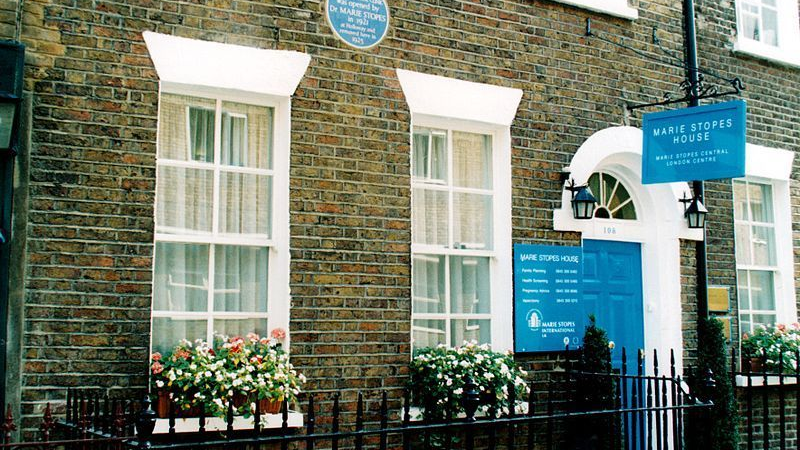
Once Tim had gained his Masters in Public Health, our family returned to England while Phil stayed on in the US to continue growing the Population Services contraceptive programme. In the mid-70s, Tim heard that the first family planning clinic in London – originally opened by Marie Stopes – was going to close. Together with Phil, we decided to buy the clinic at 108 Whitfield Street.
We continued to use Marie Stopes’ name, with support from her son Harry Stopes Roe, as a nod to the clinic’s history, and began the organisation that would support women throughout their reproductive lives and turn no one away, no matter their identity or finances.
Due to the sensitivity of providing contraception and safe abortion, it was important to buy rather than lease the clinic, to gain security of tenure in the face of opposition to reproductive healthcare. In the United States, there were bombings of abortion clinics and doctors being shot, and it felt like this could come over to the UK. As MSI’s profile increased, we were advised by security to check our cars for tampering and be constantly vigilant.
Innovating and taking on risks
MSI was a social business from the beginning, with innovation at its core. Tim tried out and designed new technologies and approaches that eventually would become the norm.
Tim innovated the way family planning and safe abortion should be delivered. He challenged the traditional ‘hospital’ style to become a more friendly, welcoming environment, with soft music, comfortable chairs, tea and biscuits and magazines. MSI clients were not ill patients – they were people seeking a solution to a problem.
Tim never shied away from provoking attention. Women used to have to stay overnight under medical supervision after an abortion, and during a campaign to end this requirement, Tim suggested lunchtime abortions in a press release. This headline of course sparked heated discussions in the media. A government minister called Tim late at night to tell him to ‘tone it down’. But as usual Tim and his team kept going and eventually this requirement would be phased out, improving abortion care in the UK forever.
As we expanded in the UK, our clinics gained contracts with the NHS to provide people with government-funded reproductive healthcare.
MSI clinics began to open in Ireland, India, Sri Lanka, Kenya and Pakistan, and more. To have seen this grow from a small, friendly clinic in London to a world-renowned charity now working in 36 countries is mind-blowing to me!
My fundamental belief
Decades before ‘working from home’ was normal, Tim often worked three days a week from a converted garden shed at our property, with me working alongside him on the secretarial side in a shed next door!
He was disciplined about not working on weekends. However, I remember one time when we had to write a funding proposal for the UK government in just a few hours. He was successful in receiving funds for a reproductive health care response in Bosnia, Yugoslavia.
At times I tried to slow Tim down, but he had an unstoppable passion to ensure people had the right to choose whether or not they had children. I am proud to have worked alongside him for over 35 years, from the early days through to his retirement in 2007. It was a wonderful moment when Tim received the CBE honour from the Queen for international family planning services.
And I am pleased that MSI has continued to grow dramatically despite the continual challenges faced. This work is as important as ever, especially with the changes we are seeing across global healthcare since the US overturned Roe v Wade and re-implemented the Global Gag Rule.
It is still my fundamental belief that people should be able to have children by choice not chance.

50 years of MSI Reproductive Choices
Read more about MSI’s five decades of delivering reproductive choice.
Mohsina: A trailblazer in Pakistan
Mohsina shares how she established MSI Pakistan in the 1990s.