

Learn about MSI’s new framework for advancing adolescent access to sexual and reproductive health and rights
Adolescence is a time of possibility, discovery and creativity. But many young people are denied the information, choices and healthcare they need to support them during this time.
Young people need to be able to make decisions about their bodies, relationships and sexual health, so they can shape their futures – whether that’s choosing education, a career, working towards financial independence, or starting a family when they’re ready.
MSI Reproductive Choices has developed a practical guide for working alongside adolescents to:
- Build community support for their sexual and reproductive health and rights
- Deliver inclusive services
- Foster supportive environments so every young person can thrive
Read MSI’s new adolescent framework and scroll down to learn more.
MSI’s new adolescent framework
MSI’s new framework for action brings together what we’ve learned from 50 years of providing services, a decade of delivering our adolescent strategy, and the latest evidence-based best practice from across the sector.
Adolescents’ sexual and reproductive health and rights is shaped by the people, systems and environments around them, not just by their own individual knowledge and choices. That’s why we’ve focused on five interconnected areas of work – progress in one area strengthens the others. For example, enabling policies support better service delivery and community engagement.
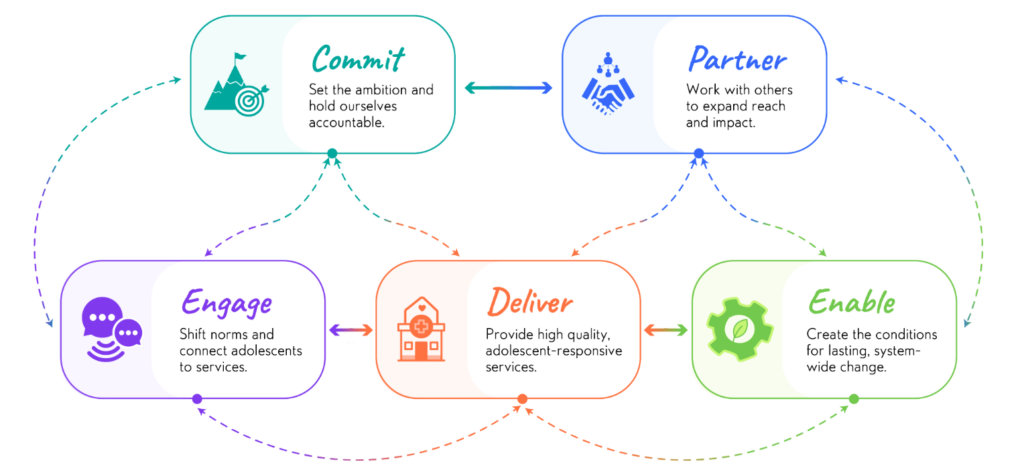
With this framework, MSI’s programmes will increasingly respond to the broader realities of adolescents’ lives including education, relationships, livelihoods, mental wellbeing, gender norms and access to quality healthcare. The framework’s guidance can be applied and adapted across different contexts.
Our teams are committed to ensuring that all young people can make informed choices.

Feature story: Teen Ella is taking charge of her life with contraception
For young people like Ella in Sierra Leone, contraception is not always readily available. But once Ella learned about it, she knew it would help her get the future she wanted.
MSI’s new approach builds from ten years of our adolescent strategy
We have long understood that adolescents face additional challenges to accessing reproductive healthcare. For example, deep social stigma and potential backlash from their parents and communities.
Since 2017, MSI’s adolescent strategy has strengthened our tailored support for teenagers so they can access contraception and abortion care in ways that suit them. Our teams have worked to reach more young people, respond to their needs, deliver information and choices, and remove policy and social barriers.
What we’ve achieved
20%
of MSI clients are aged under 20 – a threefold growth since 2017
25m
adolescents were supported by MSI teams in the past decade
620k
girls remained in school in 2025 – because they used MSI services
Top learnings
- Adolescent-responsive healthcare works best when it’s built into mainstream services (e.g. routine and public health systems) rather than housed in separate youth-only infrastructure.
- Reaching adolescents requires additional investment. Serving young people can cost up to 25% more at the start due to the extra activities needed to reach them, but costs fall over time as we build awareness and momentum in the communities we’re serving.
- Context is crucial for deciding on approaches. In the Sahel, building awareness among adolescents wasn’t enough to break down deeply rooted stigma, so we also engaged with husbands, mothers-in-law and communities. In Sierra Leone, delivering talks and services at schools contributed to a 25% reduction in teen pregnancy.
Now, MSI’s adolescent reach is triple national benchmarks. MSI’s new framework will build on this progress and ensure we can reach more adolescents, more effectively and faster.
If we can reach young people at this important turning point in their lives, it’s possible to transform the future for this generation.
It’s about saving dreams, ambitions and hope.